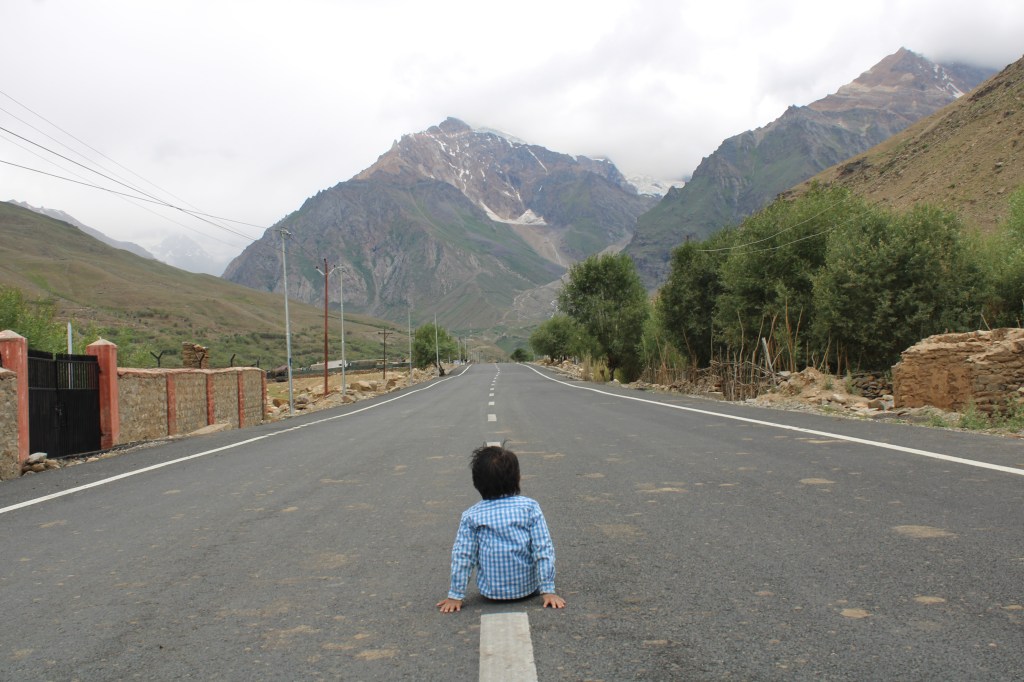

Many people think Ladakh is not possible without a private car. Specially with kids.
Even I would have thought the same if we had not done this trip ourselves.
This year we completed the first 100 days of our 1000 day travel plan. And all our time in Ladakh, we were moving around with kids using only public transport. No car, no bike of our own, no flight, no pre-booked taxis. Just buses, trains, shared vans, pickup trucks, mini trucks, and sometimes only the kindness of strangers.
And somewhere during this journey, our two and four year old kids learnt the joy of standing on the road with tiny thumbs up, asking for lift like mountain travellers. That image is going to stay with me forever.
How kids learn from travel without us teaching them
My kids have been travelling since they were four months old. I feel their first idea of public spaces and how to behave there came from trains. Earlier they wanted to run, scream, pick up anyone’s food, do whatever they felt like. Slowly they realised someone is sleeping so don’t disturb, share the seat, don’t take food without asking us, and so many small things.
For me, who grew up travelling by public transport always, these things never felt like special skills. But now when I see my kids learning them at a young age, I realise these are real life skills.
Even booking a train ticket in India feels like a skill. Then reaching station on time, finding the platform, finding your coach, settling your luggage, adjusting with others. Sometimes having long delays, sometimes running to get down in two minutes. It is all a full adventure on its own.
Starting the trip: trains and a long taxi ride
When we decided to spend some months in Ladakh this year, flights were out of our budget. So we chose the usual mix of train and road.
We boarded a train from Kanpur to Jammu. Next morning the kids were excited seeing the first mountains from the windows.
From Jammu we found a shared taxi going not only to Kargil but further to our village in Suru valley. The whole journey took around 15 hours. Kids got super bored after 10 hours and then finally slept after some crying.
But next morning when we stepped out of our new mountain home, we were surrounded by tall peaks and big glaciers shining in the sun. All the tiredness disappeared that moment.
40 days in Suru Valley
We stayed around 40 days in a beautiful village in Suru valley. We were volunteering at a government school so most of our days passed in the village itself. Sometimes we walked to nearby places, sometimes took lifts from locals, sometimes someone would give us a scooty.
There were three buses daily on the Kargil Zanskar road. Whenever we needed to go somewhere farther, we planned according to the bus timing.
Taxi from Suru to Kargil was around 2500. Public bus only around 300.
Budget makes many decisions easier.
Moving to Leh
After Suru valley, we took a bus again to Kargil and then a shared taxi to Leh for under 3000. The driver was kind and even dropped us to our homestay which was 15 minutes ahead of the taxi stand.
We lived in Leh for around two months. First at the main city and then in a village 20 km outside on the banks of Indus river.
Only a couple of times we booked a taxi. Once while shifting from Leh to the village, and once for a late night festival. Rest of the time we used whatever came our way.
Local buses
Shared vans
Mini trucks
Pickup vehicles
Hitchhiking
And sometimes walking long distances too. We even ended up walking 15 km one day when Leh was under curfew.
Taxi minimum fare in Leh starts around 500. Public transport usually cost us 20 to 50 rupees per person. For a long stay, this matters a lot.
Our kids loved it so much that the moment they reached the road they stood and started showing thumbs up for lift.
Returning from Ladakh
On our return we got to know about the JK state transport bus from Leh to Srinagar. It leaves in the afternoon from Leh, stops at Drass for night, and reaches Srinagar in the morning. Only 980 per person. Very comfortable compared to taxis.
From Srinagar our train got cancelled so we had to take a sleeper bus to Delhi. After the recent bus accident news, we will surely check safety tools, specially a hammer for emergency exit, next time.
My kids love vehicles so much now. The elder one wants to own a JCB excavator someday. I think this trip deeply shaped his imagination.
What we all learned
Public transport teaches you patience.
It teaches you to adjust.
To talk to strangers safely.
To follow systems.
To observe.
To trust.
To let go of control.
To save money.
And most importantly, to see how people really live.
Ladakh is remote, but wherever there are people, there is always a way to travel, eat and stay. It might not be convenient, but it will always be meaningful.
If we had flown directly to Leh, we would have missed all of this.
We would not understand Ladakh the way we understand it today.
Our Total Transport Cost for the 100-Day Ladakh Trip
Many people ask us how much we spent on transportation for these 100 days.
Since we had budget constraints, we used only public transport and kept our cost as low as possible.
Here is our complete breakdown from Kanpur to Ladakh and back:
- Kanpur to Jammu train: 3000
- Jammu to Suru Valley (Kargil) in shared taxi: 6000
- Suru to Kargil local bus: 300
- Kargil to Leh shared taxi: 3000
- Booked taxi twice inside Ladakh: 2000
- Rented a bike for whole day (three times): 3000
- Shared vans and buses around Leh: 1500
- Leh to Srinagar state transport bus: 3000
- Rented scooty in Srinagar: 2000
- Srinagar to Katra Vande Bharat train: 1800
- Katra to Delhi sleeper bus: 2200
- Delhi to Agra train: 1200
- Agra to Kanpur train: 400
Total: Around 30,000 rupees
(for a family of four, for the entire journey)
We know public transport is not for everyone.
Some people prefer the comfort of a private car or a booked taxi.
And that is also okay.
But if you have a limited budget like us, or if you want to experience the truest, rawest sense of travelling in India, it is much easier than you imagine.
For us, using public transport has always been our default.
It saves money, it reduces your carbon footprint, it helps you connect with local people, and it opens doors to experiences you simply cannot have inside the bubble of a personal car.
Someone might sit near you and share a story about the valley.
A stranger might play with your kids.
A driver might drop you a little ahead because you have luggage and it’s dark.
People might offer you tea at a dhaba.
All these small things make travel richer.
For our family, these rides became the heart of our Ladakh story.

 khanabadoshfamily